
Basohli
Nestled in the lower Himalayas, right on the banks of the Ravi, lies a town which was once the capital of a principality teeming with artists, musicians, palaces and a flourishing tradition of miniature paintings eponymously named after the town – Basohli.
The paintings of the Basohli idiom form the earliest known tradition of Pahari paintings, older than Kangra, Guler and Chamba. Raja Sangram Pal of Basohli is said to have commissioned the first well known set of paintings which formed the basis for the future catharses to follow– the Rasamanjari series.
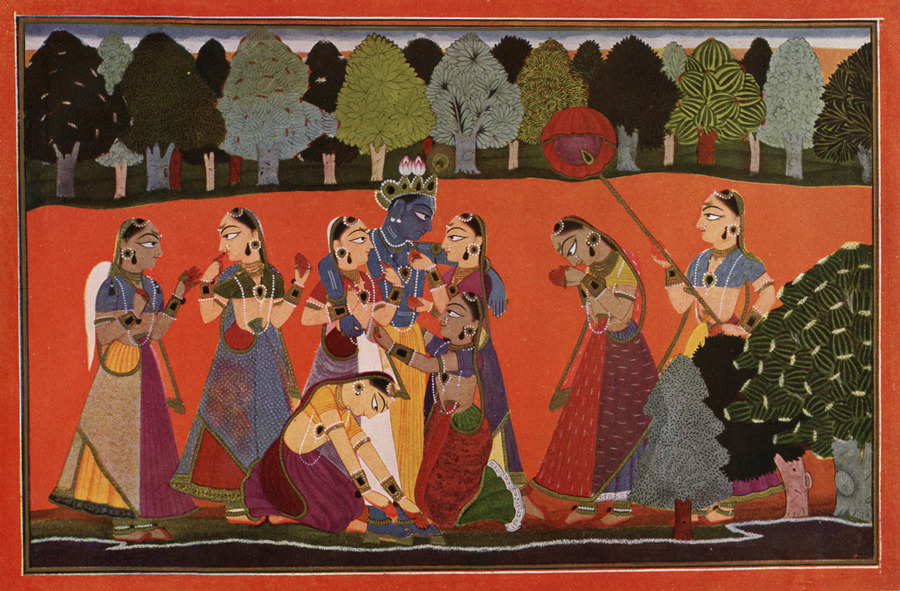
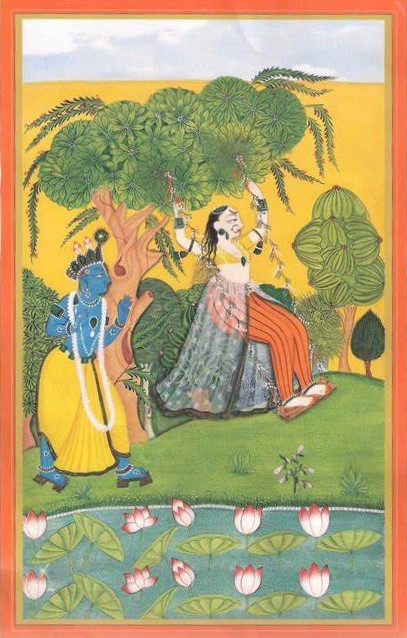
The paintings of the Basohli idiom are characterized by the use of bright colors complimenting the gentle and yet severe arching lotus shaped eyes of the characters. The characters are either embedded in sacred mythologies of the Indian subcontinent like Krishna or belong to more secular subject matter. An example of the latter would be either portraiture of the rulers of the principality or say, a night scene depicting a heroine expectantly waiting for her beloved.
A question which one might ask at this point would be this – how does one distinguish paintings of the Basohli idiom from that of the other Pahari traditions like say for example, the Kangra? The difference lies most visibly in the way the eyes of the characters are shaped. Their eyes are usually arched and lotus shaped being complemented with exquisite ornaments and attire geometrically shaped with great attention to detail. This is further juxtaposed in a setting of bright colours like Ochre-yellow or emerald green flushing out into borders of bright red.
Thus, the crowning epitome of the Basohli painting lies in its dexterous, almost revolutionary, use of colour, shape and subject matter. But even more importantly than this, what makes a painting from the tradition of Basohli important, is an astute recognition of the past. Of where we come from. The places, the characters, the use of colour, the patronage all go back to a glorious salutation to the past, expressed in an almost modern, some might call “Instagramesque familiarity”. Perhaps, this is what makes the Basohli of all the Pahari Traditions the most special. Perhaps, this is why the paintings from Basohli are called “Poetry in motion”. Perhaps, this then is why the paintings from Basohli must be patronised and remembered.